Beautiful images from Hajj 2009
(Thanks to Brother Arshad for forwarding these images)
Click on the pictures to make them bigger


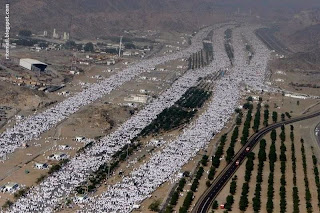


Beautiful images from Hajj 2009
Al Hijra: Islamic New Year’s Day
Al Hijra is the first day of the Islamic New Year, marking the day when Prophet Mohammed (PBUH) began his migration from Mecca to Medina in Islamic Year 1 (1 AH), 622 CE.
In 2009, Al Hijra in the UK falls on 18 December: 1 Muharram, 1431 AH in the Islamic calendar. (source: National Maritime Museum, UK)
Al-Hijra, is a low-key event in the Muslim world, celebrated less than the two major festivals of Eid-ul-Fitr and Eid-ul-Adha.
New Year rituals
There is no specific religious ritual required on this day, but Muslims will think about the general meaning of Hijra, and regard this as a good time for 'New Year Resolutions'.
Muhammad Ilyes [Ilyes84] quotes Nadvi who wrote:
"It (the advent of the 15th century) is indeed, a unique occasion to ponder that the Islamic Era did not start with the victories of Islamic wars, nor with the birth or death of the prophet (PBUH), nor with the Revelation itself. It starts with Hijra, or the sacrifice for the cause of Truth and for the preservation of the Revelation.
It was a divinely inspired selection. God wanted to teach man that struggle between Truth and Evil is eternal. The Islamic year reminds Muslims every year not of the pomp and glory of Islam but of its sacrifice and prepares them to do the same.''
A personal Hijra
The Qur'an uses the word Hijra to mean moving from a bad place or state of affairs to a good one - and so Muslims may think about how their faith helps them leave behind bad ways of living and achieve a better life.
'New Year Resolutions'
Some people may use this time to reflect everything and seek to improve their iman (belief). Some people may argue that Ramadan is the time to reflect oneself and make changes and may regard this "new years thing" as just another innovation. Personally I believe there is no harm in that i.e to improve ones iman whatever the day in the year. If you decide to make resolutions, then read the following advice on "Ten useless matters" and think about what you can do to improve youself. It would have been easy to write a list of resolutions to think over based around the five pillars of Islam, but the list of "ten useless matters" should make you think on what we are doing wrong and correct them accordingly.
Ten useless matters
(taken from lutonmuslims)
1. Knowledge that is not acted on.
2. The deed that has neither sincerity nor is based on following the righteous examples of others.
3. Money that is hoarded; as the owner neither enjoys it during this life nor obtains any reward for it in the Hereafter.
4. The heart that is empty of love and longing for Allah; and of seeking closeness to Him.
5. A body that does not obey and serve Allah.
6. Loving Allah without following His orders or seeking His pleasure.
7. Time that is not spent in expiating sins or seizing opportunities to do good.
8. A mind that thinks about useless matters.
9. Serving those who do not bring you close to Allah; nor benefit you in your life.
10. Hoping and fearing whoever is under the authority of Allah and in His hand; while he cannot bring any benefit or harm to himself; nor death; nor life; nor can he resurrect himself.
However the greater of these matters are wasting the heart and wasting time. Wasting the heart is done by preferring this worldly life over the Hereafter; and wasting time is done by having incessant hope. Destruction occurs by following one’s desires and having incessant hope; while all goodness is found in following the right path and preparing oneself to meet Allah.
How strange it is that when a servant of Allah has a [worldly] problem; he seeks help of Allah; but he never asks Allah to cure his heart before it dies of ignorance; neglect; fulfilling one’s desires and being involved in innovations. Indeed; when the heart dies; he will never feel the significance or impact of his sins.
Further reading:
(1) Story of the Prophet’s Hijrah - islamonline.net
(2) A Brief Introduction ToThe Islamic (Hijri) Calendar - Dr Waleed A. Muhanna
(3) What is the proper way of celebrating the Islamic New Year? - islamonline.net
(4) The best of the best, Have you ever wondered to yourself what it actually means to be the best? - lutonmuslims.co.uk
In the name of Allah most gracious most merciful
Assalaamu alaykum wa rahmatuallahi wa barakatuhu
1. Start off each day with 'adhkaar al-istiyqaadh' (waking up Supplications), thanking Allah for waking up in good shape.
2. Put Allah first in your life.
3. Broaden your horizons - learn 5 new verses from the Quran every day, travel to pray far in the mosque to brighten your day,take up a booklet having supplications and read them.
4. Pray Salaat Al-dhuhaa (after sunrise).
5. If someone says something mean to you, just shrug it off and dismiss it in a friendly, laidback manner; and pray that Allah shall forgive them.
6. When you get angry, remember Allah; and how short and worthless life is to waste in being Angry.
7. Remember that you can never have too many friends, but you can have few quality friends that help you fulfill the purpose of your creation (i.e. live for Allah).
8. When you're happy, try to share your happiness with others. Thank Allah for that, and pray its continuation.
9. When something bad or embarrassing happens to you, just think that it could always be worse, remember the reward of patience,and thank Allah that it's not worse than it is.
10. Do something extra of goodness once in a while, like feeding a poor person, or caressing an orphan's head.
11. Never stop believing that you can win Allah's love and thus work for it. Then you can win the love of Allah's slaves.
12. Spend some time thinking of Allah's amazing creation.
13. Always love those who love Allah unconditionally. This way you will ensure that you live for Him, love for Him, and hate for Him(those who are enemies of Him).
14. Find the righteous ways to express yourself, and if you think what you are about to say shall cause no benefit, maintain silence (this is tough!!).
15. Every now and then, give yourself a break. Play sports, give time to your family, friends, but always remember Allah and watch that He is watching you.
16. Pray for blessing to come to those being lost, and pray to Allah to guide them to the right path.
17. Hug your parents, kiss their hands and heads and always obey but stop at Allah's orders.
18. Smile to everyone, for your smile makes a big difference to him or her and you are rewarded.
19. Forgive, forget and smile.
20. Tears are not for women only... tears are for all human beings with feelings remaining in them. Don't restrain your tears when remembering Allah.
21. When people criticize your actions and effort, revise your actions and see if they please Allah or not. If they do; then ignore and remember how the Prophet (SAW) and the Sahaba were criticized, made fun of and even physically harmed, so have patience.
22. Read the Quran daily and try to have a schedule for completing it as much as you could. As you open the Quran daily, read with observation not just passing your eyes through the words.
23. Don't let popularity go to your head, for it never lasts and you may lose from it more than gain.
24. Never look down on anybody, for, to Allah they may be better than you.
Taken from BBC News, Friday, 10 July 2009
A conman who tricked religious pilgrims out of hundreds of thousands of pounds has been jailed for six years.
Mohammed Faruk Ahmed pleaded guilty to using money meant for the Muslim pilgrimage to Mecca and spending some of it in casinos and betting shops.
Police say Ahmed conned at least 300 people in London's East End, many of whom devoted their life savings to the 2008 Hajj pilgrimage.
The Metropolitan Police is recovering some cash from accounts in Bangladesh.
Ahmed, of Brick Lane in London, was running a travel agency called Qibla Hajj Kafela Services.
He was offering to organise trips to the annual pilgrimage in Saudi Arabia - but was in fact preying on the local Bangladeshi community and Muslims in other parts of the country.
The 41-year-old took payments of almost £2,000 per client, amassing £570,000 from 300 victims.
Instead of using the cash to secure visas, flights and hotels in Mecca, Ahmed went on a gambling spree in casinos and bookmakers - and then fled abroad.
Meanwhile concerned pilgrims began calling the Metropolitan Police asking for help. They had received no travel documents and the deadline to obtain Hajj visas from the Saudi embassy was fast approaching.
Office raided
Officers raided Ahmed's premises and discovered the 300 passports and paperwork showing £250,000 had been secretly moved from his business account to Bangladesh.
Detective Inspector Des McHugh of the Metropolitan Police told the BBC his team worked around the clock to ensure as many passports as possible were returned to victims so they could still submit them to the Saudi embassy for a pilgrimage visa.
"Ahmed shamelessly defrauded hundreds of innocent victims who had planned the most significant trip of their lives," said Det Insp McHugh.
"We worked hard to investigated the full scale of Ahmed's crime and officers placed themselves under additional pressure to process evidence and return passports to victims as soon as possible," he said.
Detectives eventually arrested Ahmed when he returned to the UK.
The £250,000 moved to Bangladesh had been frozen by court order, pending Ahmed's jailing. Officers are now finalising steps to return the cash to the UK so victims can make recovery claims.
"In many cases victims lost their entire life savings but still managed to retain their dignity and supply significant evidence to our investigation team," said Det Insp McHugh.
"Thanks to them and to a thorough police investigation Ahmed had no choice but to plead guilty," he said.
Taken from islamiccentre.org
Question: I have been thinking of something bad to do but didn't really have the guts to do it - so will I get punish for even thinking about it?
Answer:
There is a famous Hadith Qudsi which has been reported by Imam al-Bukhari in his Sahih.
The Prophet (peace and blessings of Allah be upon him) said: Verily Allah has written the good actions and the bad actions and has then explained them. So whosoever intends a good deed and then does not carry it out, Allah will grant him one full unit of reward.
If the person intends a good deed and does carry it out, Allah will then grant him anything between ten and seven hundred units of rewards, and beyond.
Whosoever intends a bad action and then does not perform him, Allah will right a good deed for him. If the person intends a bad action and then perform its, Allah will write for him one unit of sin.’
From this beautiful narration, we learn that if a person intends to do a bad action, but then does not carry it out, then Allah will actually reward him for refusing to carry out that bad action.
It must be noted however, that this applies to when a person intended a bad deed, and then did not carry it out because of his fear of Allah.
If he didn’t carry it out because he was thwarted, then this is deemed as a sin. For example, if a person was about to rob a bank, but then stopped due to his fear of Allah, he will be rewarded. If he stopped because he did not have a weapon with him, or because his transport was inadequate and so on, then he will be punished.
Taken from Islamic Times, Tuesday, 16 May 2006
With the passing of Mothers day in the UK recently. We decided to look at the Islamic perspective on how Muslims should treat this annual concept. The date of Mother's Day, and the way in which it is celebrated, differs from one country to another. In Norway it is celebrated on the second Sunday in February. In Argentina it is celebrated on the second Sunday in October. In Lebanon it is on the first day of spring.
In South Africa it is celebrated on the first Sunday in May. In France it is celebrated more as a family festival, on the last Sunday in May, when family members get together for dinner, and then they give a cake to the mother. In Japan this day is celebrated on the second Sunday in May, as in North America, where exhibitions are held of pictures drawn by children aged 6-14; these exhibitions are called "My Mother" This exhibition is moved every four years and has appeared in a number of countries.
How did it start in England?
In England the modern Mother's Day celebration, began as "Mothering Sunday" or (the Sunday half-way through Lent), because it occurred during their major fasting period (Lent). Some say that the celebrations that were held to worship and honour the Roman false goddess Sybil were changed by the church to celebrations meant to honour and venerate Mary (peace be upon her).
This custom began with some people encouraging people to visit the central church in their locality, bringing offerings. In the year 1600, young men and women of simple professions and servants started to visit their mothers on "Mothering Sunday", bringing gifts and food. Nowadays it is celebrated by non muslims on the last Sunday of March each year
The Islamic Perspective - Honouring the Mother
Allaah says (interpretation of the meaning): "Worship Allaah and join none with Him (in worship); and do good to parents, kinsfolk, orphans, Al-Masaakeen (the poor), the neighbour who is near of kin, the neighbour who is a stranger, the companion by your side, the wayfarer (you meet), and those (slaves) whom your right hands possess. Verily, Allaah does not like such as are proud and boastful" [al-Nisa' 4:36] And Allaah says (interpretation of the meaning): "And your Lord has decreed that you worship none but Him.
And that you be dutiful to your parents. If one of them or both of them attain old age in your life, say not to them a word of disrespect, nor shout at them but address them in terms of honour" [al-Isra' 17:23]
It was narrated that Abu Hurayrah (may Allaah be pleased with him) said: "A man came to the Messenger of Allaah (peace and blessings of Allaah be upon him) and said: 'O Messenger of Allaah, who among the people is most deserving of my good company?' He said, 'Your mother.' He asked, 'Then who?' He said, 'Your mother.' He asked, 'Then who?' He said, 'Your mother.' He asked, 'Then who?' He said, 'Then your father.'" (Narrated by al-Bukhaari, 5626; Muslim, 2548)
Al- Haafiz ibn Hajar said: "Ibn Battaal said: what this means is that the mother should be honoured three times more than the father. He said, that is because of the difficulties of pregnancy, then giving birth, then breastfeeding.
These are hardships that are experienced only by the mother, then the father shares with her in raising the child. This is also referred to in the aayah (interpretation of the meaning): 'And We have enjoined on man (to be dutiful and good) to his parents. His mother bore him in weakness and hardship upon weakness and hardship, and his weaning is in two years' [Luqmaan 31:14]
So the recommendation to be dutiful and good refers to both parents, but the mother's share is greater because of the three things mentioned above.
Al-Qurtubi said: what is meant is that the mother deserves a greater share of her child's honour, and her rights take precedence over those of the father in cases where a choice must be made.
'Iyaad said: the majority of scholars were of the view that the mother takes precedence over the father in terms of honouring one's parents.
And it was said that both must be honoured equally, and this was narrated by some from Maalik, but the former view is the one which is correct." (Fath al-Baari, 10/402).
Indeed, even if one's mother is a mushrikah (polytheist), the wise and pure sharee'ah of Islam encourages one to uphold ties of kinship with her: It was narrated that Asma' bint Abi Bakr (may Allaah be pleased with them both) said: "My mother came to visit me at the time of the Messenger of Allaah (peace and blessings of Allaah be upon him) and she was a mushrikah. I consulted the Messenger of Allaah (peace and blessings of Allaah be upon him), saying, 'My mother has come to visit me for some purpose, should I uphold ties of kinship with my mother?' He said, 'Yes, uphold ties of kinship with your mother.'" (Narrated by al-Bukhaari, 2477)
It is extremely unfortunate that Muslims throughout the world have begun to adopt and practice western ideas and understanding when it comes to the quality of relationship between the mother and child.
For Muslims to begin to selfishly adopt a single day out of the whole year to express gratitude and show a materialistic form of affection.
Islam has no need of things that are innovated by others, be it Mother's Day of anything else. Its teachings on the honouring of mothers mean that it has no need for an innovated Mother's Day.
Standing Committee for Academic Research and Issuing Fatwas issued a statement: It is not permissible to celebrate the so-called Mother's Day and similar innovated festivals because the Prophet (peace and blessings of Allaah be upon him) said: "Whoever innovates something in this matter of ours (Islam) that is not part of it will have it rejected."
He (peace and blessings of Allaah be upon him) did not celebrate Mother's Day and neither did any of his companions (may Allaah be pleased with them) or the salaf (earliest generations) of this ummah. Rather it is an innovation (bid'ah) and imitation of the non Muslims.
"This day, I have perfected your religion for you, completed My Favour upon you, and have chosen for you Islam as your religion" [al-Maa'idah 5:2] Fataawa al-Lajnah al-Daa'imah, 3/86 In light of this, Muslims should be aware that honouring and showing sincere affection and gratitude to the mother is a full time duty that should be practiced each and everyday of ones life, to merely set aside a single day and feel you have fulfilled their rights is a gross misconduct to the parents and the teachings of the Prophets (peace and blessings of Allaah be upon him).
"And We have enjoined on man (to be dutiful and good) to his parents. His mother bore him in weakness and hardship upon weakness and hardship, and his weaning is in two years give thanks to Me and to your parents. Unto Me is the final destination" [Luqmaan 31:14]
And Allaah knows best.
Further Reading: mothers-day-from-islamic-perspective